
Talk Never Paid a Bill
A billionaire is promising to make Georgia the most affordable state in America. In a state that is one-third Black, the only question that matters is: affordable for whom?

Rick Jackson likes to say that talk never paid a bill.
It’s the sharpest line in his Action Plan, and he’s right. So let’s take him at his word — and do the arithmetic on his.
Jackson enters November having spent more than $108 million of his own fortune, most of it on television, to wrest the Republican nomination from a Trump-backed lieutenant governor with a wealthy family name. A healthcare executive who grew up in five foster homes, he tells a genuine rags-to-riches story and vows to “run the state like a business.” “As governor,” he said at a July rally, “I will treat affordability like a crisis.”
He’s right that it is one — groceries, rent, and premiums are squeezing Georgia families of every color. But a crisis has victims, and it has a bill, and this election is a fight over who gets relief and who gets the invoice. Lay his platform against the ledger of who actually lives here, and a pattern his ads never show you emerges: the relief flows up, the bill flows down.
And in a state where a third of us are Black, “down” has an address we know by heart.
The ghost of Mississippi
I have people in Mississippi, and so does the policy Jackson is selling.
His signature promise — the one he’s staked his candidacy on — is to cut Georgia’s state income tax in half within four years and eliminate it entirely within eight. “I will cut Georgia’s income tax in half, or I won’t run again,” he says. It sounds like a gift to every working family. It is not.
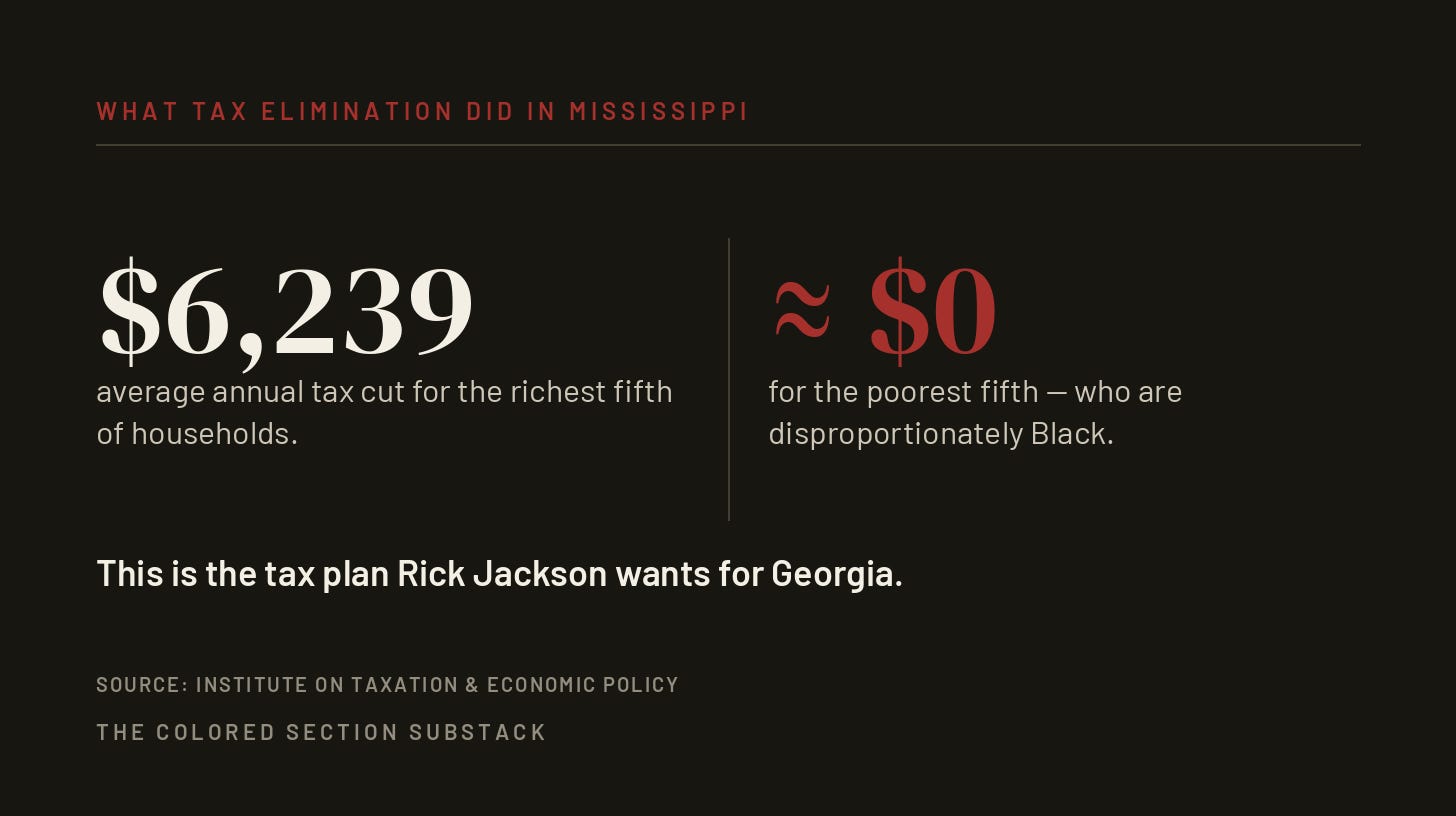
We don’t have to guess what income-tax elimination does, because Mississippi is already doing it, and the Institute on Taxation and Economic Policy has run the numbers. When Mississippi moved to zero out its income tax, the top fifth of households pocketed an average cut of more than $6,200 a year. The bottom fifth — disproportionately Black — got essentially nothing. Of the billions in total cuts, roughly 72 percent flowed to white households and about 26 percent to Black households, even though Black families file some 40 percent of the state’s tax returns.
Black families, the plurality of taxpayers, received barely a quarter of the benefit. This is not an accident of Mississippi’s design; it is the physics of the policy.
The income tax is the one progressive instrument in almost every state’s tax code — the one levy that asks more of those with more. Every other major tax a state collects, especially sales and excise taxes, is regressive, taking a bigger bite of a poor family’s income than a rich one’s.
Strip out the income tax and you don’t just cut a tax. You remove the counterweight, and you tilt the entire system toward the people who spend every dollar they earn to survive. To replace the lost revenue — and eliminating the income tax would blow a multibillion-dollar hole in Georgia’s budget — a state has exactly two options: raise the regressive taxes that hit us hardest, or gut the public services we rely on most. Usually it does both.
So when Jackson promises to eliminate the income tax, hear what he is actually promising. He is promising the largest checks to the Georgians who need help least, paid for by the Georgians he says he’s fighting for.
The sleight of hand in the property tax freeze
Give the man this: his property tax freeze is his most defensible affordability idea, and for some Black homeowners it could mean real relief. There’s an ugly truth buried in property taxation — assessors have a documented habit of over-valuing lower-priced homes, which are disproportionately Black-owned, so Black homeowners often pay more in property tax relative to what their homes are actually worth. Freezing runaway assessments could genuinely protect longtime homeowners in gentrifying Atlanta neighborhoods from being taxed off their own front porches.
But watch the hand that isn’t moving.
A freeze does nothing for renters — and Black Georgians rent at higher rates and are more likely to be cost-burdened by it. And property taxes are the tap that funds local schools. Freeze the tap statewide without replacing the water, and the districts that get starved first are the ones already running dry: rural, under-resourced, and Black. The homeowner in Buckhead and the homeowner in Bartow both get their freeze. Only one of them was counting on that revenue to keep the local school’s lights on.
The coverage gap is a color line
Here is the plank that should end the conversation about whether this man will fight for Black Georgians, because it is where his expertise and his silence collide.
Rick Jackson made a billion-dollar fortune in healthcare. His company held state contracts worth more than a billion dollars. And his policy platform does not contain a single plan to lower the cost of care or expand who can get it. He opposes Medicaid expansion — the one move that would do the most, fastest, for the most people.
Consider who lives in Georgia’s coverage gap, that cruel space where you earn too much for Medicaid and too little to afford a marketplace plan. The Georgia Budget and Policy Institute finds that about 36 percent of the people trapped there are Black. Roughly one in seven Black Georgians is uninsured. Georgia’s Republican leadership has offered “Pathways to Coverage” — a program smothered in work-reporting paperwork — as its answer, and the results are a monument to the difference between a bridge and a barrier: after more than a year, it had enrolled only a few thousand people out of the hundreds of thousands who would qualify under real expansion, with most of the money spent on administration rather than care.
Meanwhile rural hospitals keep closing, and they close in the majority-Black counties of south and middle Georgia where the nearest emergency room is already an hour of bad road away. Jackson gestures at “more rural health care options.” An option is not a hospital. A slogan is not an insurance card. On the one issue where he knows more than any candidate on either ticket, he has chosen to defend the status quo that made him rich — the status quo that is, for Black Georgians, a slow-motion emergency.
Revolving doors, and who walks through them
Jackson pledges to “ban revolving-door justice,” reject “soft-on-crime policies,” and back law enforcement without reservation. It plays well in a rally. It reads differently when you know the numbers.
Black people are about 31 percent of Georgia’s adult population and roughly 61 percent of the people it locks up. For years the imprisonment rate for Black adults ran more than triple the rate for white adults. And here is the part Jackson’s ads won’t mention: the last time Georgia meaningfully closed that gap, it was a Republican governor who did it. Nathan Deal’s bipartisan sentencing and diversion reforms helped drop Black prison admissions by roughly 30 percent in under a decade. Those reforms are precisely the kind of policy that “revolving-door” and “soft-on-crime” rhetoric exists to reverse. Jackson is campaigning to undo the one conservative achievement of the last generation that actually helped Black Georgians — and to call it public safety while he does it.
The dignity argument
Jackson wants to tie public assistance to work or job training for able-bodied adults, because, he says, “creating dependency is not compassion.” It’s a philosophy with real moral force, and plenty of Black families believe in the dignity of work as fiercely as he claims to. But we’ve already seen what “work requirements” mean in practice in this state: Pathways proved that in Georgia, a work requirement doesn’t function as a ladder. It functions as a lock on the door. It didn’t move people into jobs; it moved eligible people off the rolls and called the savings a success. Dignity that arrives as paperwork designed to disqualify you is not dignity. It’s abandonment with a mission statement.
The southern tongue
During the primary, Jackson promised he’d be “like Trump, but with the southern tongue” — “President Trump’s favorite governor.” He drew a careful distinction on diversity, too: “I believe in diversity and inclusion. I don’t believe in equity,” he said, calling the pursuit of equal outcomes “communism.” Sit with that framing. It welcomes us in the room and forbids us the thing the room was supposed to deliver. Inclusion you can put on a brochure. Equity is the part where the bill actually gets paid — and that’s the part he calls dangerous.
Here is where the arithmetic lands. Georgia is one-third Black not by accident but by history — by the labor and the roots and the refusal to leave of people who built this state and were never meant to inherit it. That third is not a demographic footnote. In 2020, in 2021, in the runoffs that shook the country, it was the margin. It is the margin again now.
Rick Jackson is betting more than a hundred million dollars that affordability, sold in a southern tongue, will be enough to win a sliver of that margin over — or to keep enough of it home. The counter to a hundred million dollars has never been another hundred million. It has always been us, awake, counted, and at the polls. He’s right that talk never paid a bill.
Neither did staying home.
—
The Colored Section publishes long-form editorial on Black people, pop culture, and political power in the South, Sources for the figures cited here include the Institute on Taxation and Economic Policy, the Georgia Budget and Policy Institute, the Sentencing Project and Vera Institute of Justice, AdoptUSKids, and the candidate’s own Action Plan and public remarks.
This is profound. Thank you for writing this.
New Yorker here, I’m rooting for the good people of Georgia to elect Keisha Lance Bottoms🗳️👏🏾👏🏾👏🏾